Computational Morphogenesis and Evolutionary Design Computation
In nature, the totality of the developmental sequence of a biological system from origination to mature state as well as the evolution of morphological structures is called morphogenesis. In morphogenetic processes system intrinsic information and material capacities interact with environmental influences and forces to create ever more complex organizations, forms and structures. This increasing morphological differentiation, the summary process of each system-element’s response and adaptation to its location within the overall system and its surrounding environment, results in the astounding functional integration, performative capacity and material resourcefulness ever present in nature, even in the simplest of organisms.
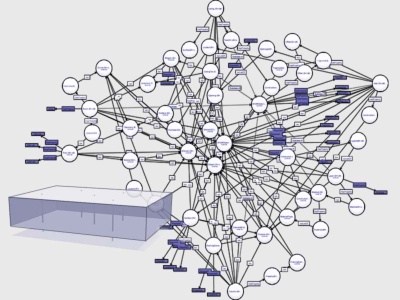
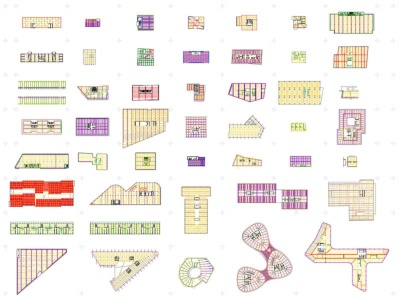
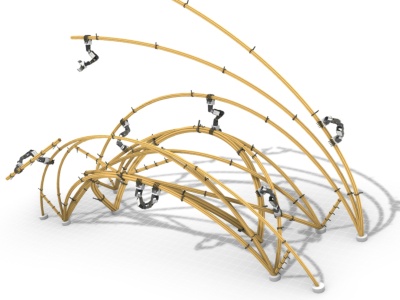
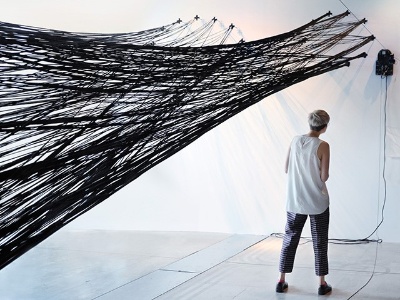
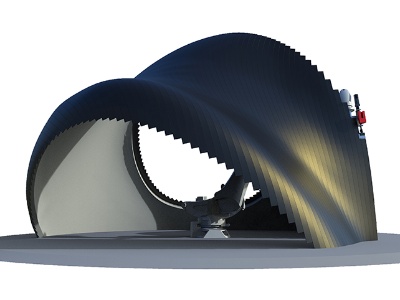
The research of the Institute for Computational Design investigates how the underlying principles of morphogenesis present relevant concepts for the development of computational design in architecture. Both the ontogenetic aspects, referring to the course of development and growth of an individual, and the evolution across many generations of populations of individuals provide a conceptual framework for an understanding of computational design as variable processes of algorithmic development and formation. In natural morphogenesis, it is process that produces, differentiates and maintains biological morphology. These processes of continual becoming consist of a complex series of interactions and exchanges between the biological system and its environment. Most of these processes are controlled by feedback. Moreover, it is important to note that the feedback-driven production, elaboration and differentiation continuously effect most constituents of natural systems. In this way, growth and adaptation are continuous processes of reconstruction resulting in increasingly heterogeneous and hierarchically structured systems. ICD’s research on computational morphogenesis in architecture considers the importance of resolving the complexity originating from the interrelation and reciprocal effects of material systems and dynamic environments by integrating both the state that defines the parameters of materialisation and the one that describes the influences which will activate the physical constraints to organize and arrange in a specific manner. These computational processes are iterative, recursive and expanding, with the possibility of continuously rewriting parts of the entire system based on feedback information with external data. Therefore, they can be considered as both explorative and ecologically embedded, especially if evolutionary dynamics are also integrated.
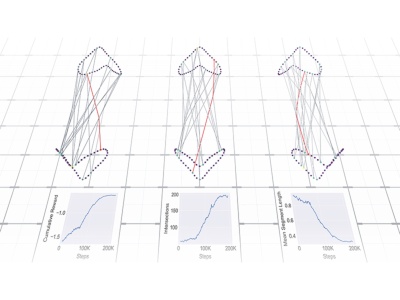
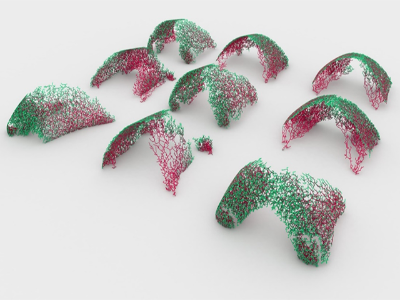
Evolutionary strategies for computational optimization have been investigated for more than four decades in engineering and computer science. Here the principles of natural evolution such as heredity, reproduction, genetic recombination, mutation and selection are integrated in metaheuristic computational search processes. As of yet, evolutionary algorithms and evolutionary computation are mainly used as stochastic optimization processes. However, based on the intention to converge on optimized solutions for known problems, the deterministic, goal-oriented character of these processes is in contrast to the nondeterministic, open-ended quality of natural evolution. Thus ICD’s research focuses on the effectiveness of evolutionary computation to derive unconsidered or hitherto unknown possibilities while maintaining an overall performance level.
Architectural design, not dissimilar to natural evolution, is an open-ended process that profoundly differs from engineering optimization. If at all, optimized solutions can only be found for design objectives that can be quantitatively expressed. Thus, and in line with the underlying characteristics of natural evolution, in architecture the use of evolutionary computation as an explorative rather than an optimisation process is more promising by far. The open-ended nature of evolutionary computation is of particular interest for architecture, as a design task can usually not be comprehensively described as a problem, but rather as an opportunity for creating novel possibilities within the framework of a given brief. Correspondingly, evaluation criteria and design objectives tend to co-evolve with the development of a project. Here, evolutionary processes are more about finding than searching, about the continual extension of the search space through novel solutions that emerge as the by-product of evolutionary dynamics. In design, evolutionary processes offer variational methods based on extensibility instead of typology. Rather than reiterating, recombining and simply varying existing concepts and design knowledge fused into the description of type, evolutionary computation and related population thinking provides for truly explorative processes with the capacity to discover and unfold novel design possibilities.
Back to previous page Research Research Objectives
777 articles in total | Legal Notice |